
Running a Sex Offender Check in Blount County
The Alabama Law Enforcement Agency manages Alabama's registry through its Criminal Justice Information Services Sex Offender Registry Unit. ALEA routes the public to the official Community Notification search. The Blount County Sheriff's Office also directs readers through a disclaimer gate to sex-offender information. Both paths point toward the state notification data rather than a separate county database.
Start with the question. A name search helps identify a known person. An address or geographic search addresses nearby registration records. The Blount County sheriff is the right local contact when an address, required report, or compliance status needs review. For the conviction itself, use the court that entered judgment because a registry summary cannot replace a docket, judgment, or sentencing order.
Blount Registry and NSOPW Coverage
The Alabama source and the national source answer related but different questions. ALEA's registry is the state authority for Alabama data and Blount County compliance. The National Sex Offender Public Website, or NSOPW, searches participating jurisdictions across state lines. NSOPW is useful when a person may have moved, uses an alias, or has ties outside Alabama. It does not take over the sheriff's local registration role.
The official NSOPW search screen shows the cross-state layer before a reader chooses a search path.
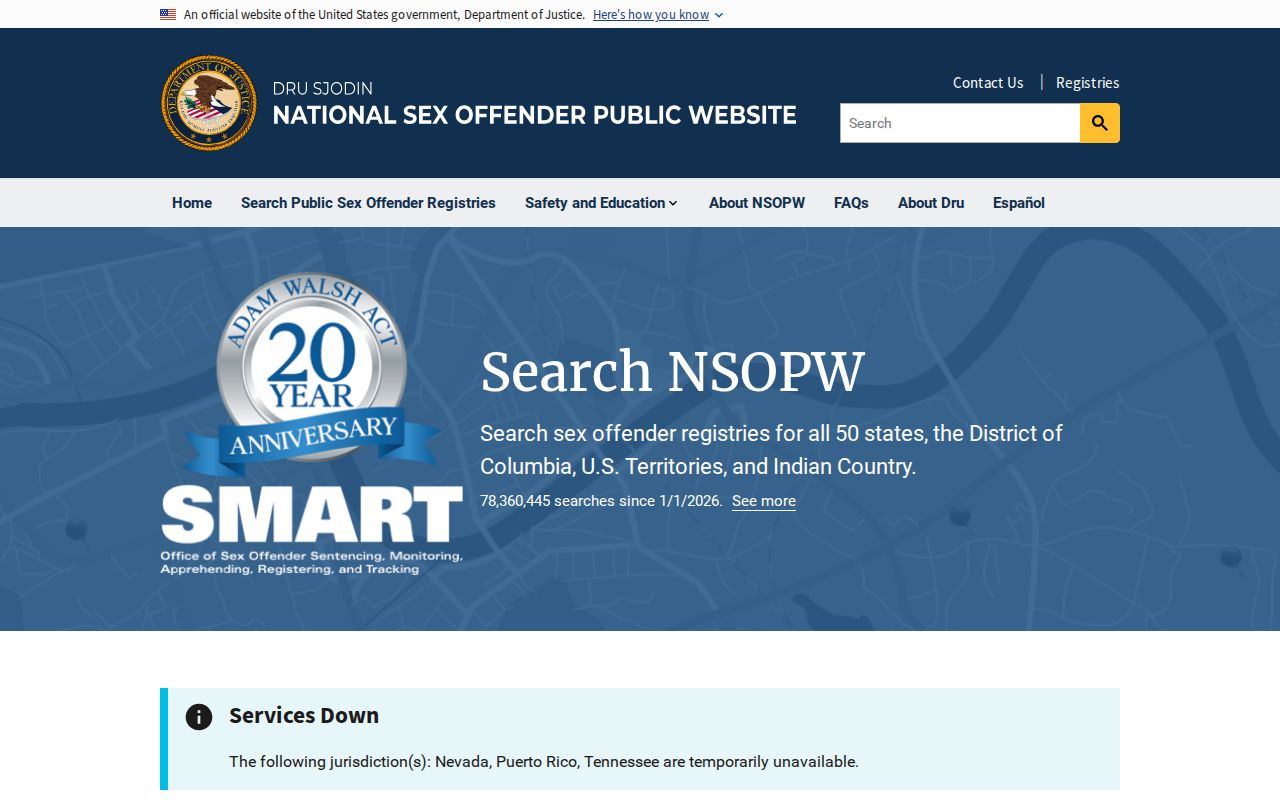
That national view can widen a Blount County registry check, but Alabama and local law enforcement remain the sources for current Alabama reporting questions.
Searching the Alabama Sex Offender Registry
ALEA's public path leads to the Alabama Sex Offender Registry search. The live interface can change and may use a browser challenge, so field labels should be read as they appear at search time. State law requires search access by name and by geographic locators. Do not invent a radius if the live screen does not display one.
- Open ALEA's registry path, enter the official search, and read the lawful-use terms before continuing.
- Use a name and aliases for an identity question. Use city, county, ZIP, address, or a displayed radius control for a location question.
- Review both map and list results when offered. Match the photograph, descriptors, aliases, and registering agency instead of relying on a similar name.
- Open the public profile and note the address display, status, offense information, and update details. Call the sheriff when a Blount County entry raises a compliance concern.
| Search control | Type | Required | Verified use |
|---|---|---|---|
| Name search | Text fields | At least one locator | Required as a search method by Alabama law; confirm the current component labels. |
| City, county, ZIP | Text or dropdown | Depends on search | Geographic locators required by the public-access statute. |
| Address and radius | Geographic controls | Depends on search | Use values shown live; inspected research could not verify the exact radius menu. |
| Map and list | Result views | No | Notification views, not proof that a person is present at an address. |
| Alert enrollment | Contact and address fields | Varies | Confirm the live event and delivery terms before enrolling. |
Use the narrowest search that fits the question, then try known aliases or a place search if the first query misses. A no-match message is only a public-search result, not a certified statement about a person's complete history.
Blount Registry Public Coverage Limits
Only offenses listed in Alabama Code § 15-20A-5 appear on ALEA's public site. A blank result does not prove that a person has no sex-offense history, no sealed or restricted matter, or no legal registration duty. Spelling, aliases, a recent move, reporting lag, and the statute's coverage rules can all affect what a public search returns.
ALEA's registry FAQ explains the public-coverage boundary and the role of community notification.
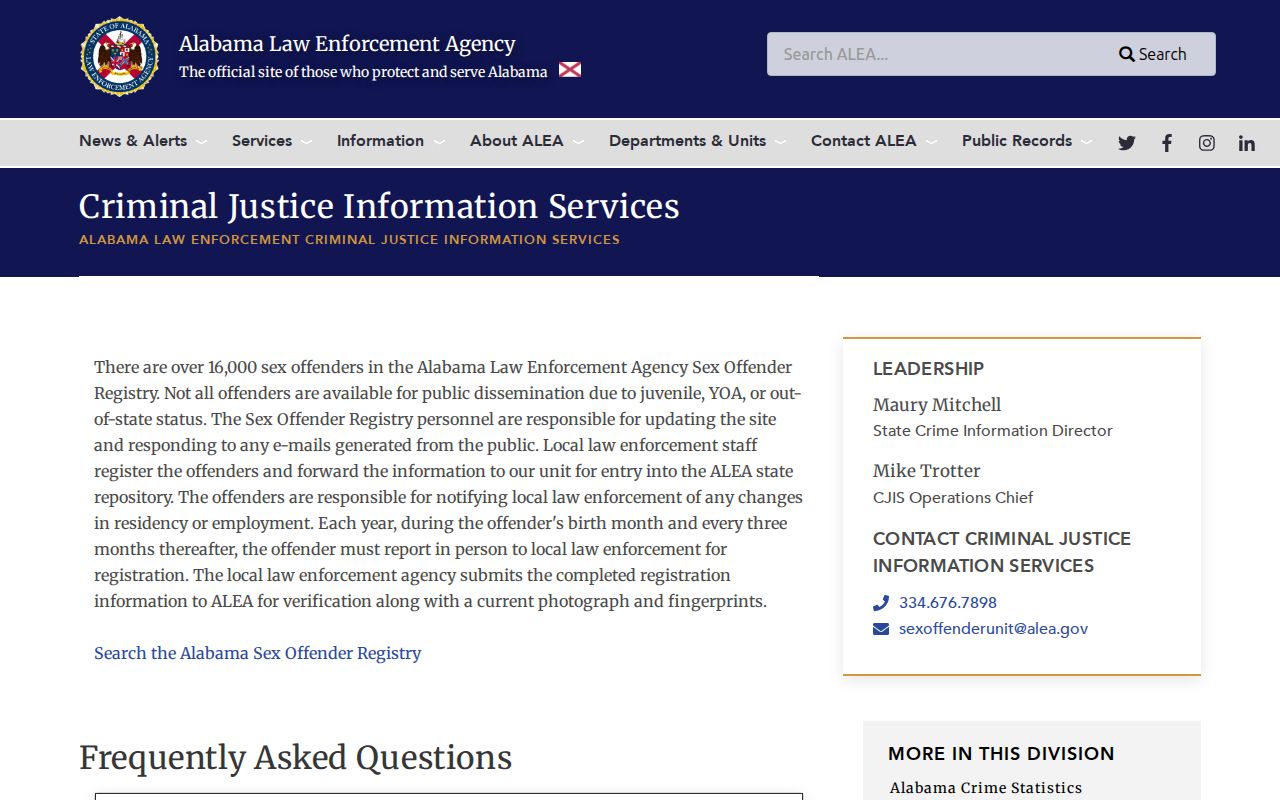
The FAQ makes a key point for Blount County searches: the public registry publishes what ASORCNA directs, not every court event involving a sex offense.
What a Registry Profile Shows
An Alabama public profile is built for identification and notification. Exact fields depend on the statute and on information supplied to ALEA. Compare several fields before deciding that a result matches the person or place at issue. A listed residence is registration information, not permission to approach a home or contact anyone there.
| Name and aliases | Displayed identity names that can help separate similar results. |
|---|---|
| Photographs and descriptors | Primary or added images, sex, race, age or birth date, height, weight, hair, eyes, scars, marks, and tattoos where published. |
| Registered location | Current residence or address information and other statutory locations where available. |
| Offense information | Offense description, jurisdiction, conviction date, and victim-age category when public under the Act. |
| Agency and status | Registering agency plus a displayed compliance or absconded status. |
| Other registration data | Vehicles, school information, and other items that the law directs ALEA to publish. |
Public fields may lag a recent report. The Blount County sheriff can address local status questions, while the issuing court holds the source conviction record.
Blount Registry Status Versus Conviction
A compliance or absconded flag describes registration administration. It is not, by itself, a new conviction. The profile may summarize the qualifying offense, but a case docket shows the charge filed, hearings, plea or trial, judgment, and sentence. Those records can also clarify whether a similarly named person is the same person shown on the registry.
When the underlying case arose in Blount County, the court file can be followed through the Blount County criminal court case records process. If another county or state entered the judgment, contact that court. Keep the two products distinct: the registry supports notice, while the court documents the prosecution and outcome.
Registration Requirements and Levels in Alabama
Alabama's adult system is not a public Tier I, Tier II, and Tier III chart. Covered adults generally register for life and report in person during the birth month and every three months after that under § 15-20A-10. Juvenile low, moderate, and high categories govern notification, while duration depends on the adjudication and statutory route. Federal tier durations should not be pasted onto a Blount County result.
| Alabama category | Duration | Reporting or visibility |
|---|---|---|
| Covered adult | Generally lifetime, subject to narrow statutory relief | In person in the birth month and every three months thereafter, plus required change reports. |
| Specified serious juvenile adjudication | Can be lifetime | Notification follows Alabama's juvenile category rules and current statute. |
| Other covered juvenile adjudication | Generally 10 years | Low, moderate, or high categories govern notification; exact duties require the order and statute. |
| Qualifying lifetime juvenile petition | Relief may be sought after 25 years | Relief is not automatic and depends on § 15-20A-34. |
The court order and current Alabama statute control the duty in a specific case. The public profile should not be used to assign a federal tier that Alabama does not publish.
Blount County Registry Distance Rules
ASORCNA includes 2,000-foot residence and employment restrictions tied to schools, childcare facilities, resident camps, and specified victim locations. Section 15-20A-11 uses detailed definitions, exceptions, and a straight-line property-line measurement. A map estimate is not an address approval. Local law enforcement handles that review.
Notification distance differs by population. Oneonta, with at least 5,000 people, uses a 1,500-foot notification range. Places below 5,000 and unincorporated Blount County use 2,000 feet. Schools and childcare facilities within three miles receive notice. These notice zones should not be confused with the separate residence and employment restrictions.
The ALEA Community Information Center provides the state gateway for registry and alert functions.
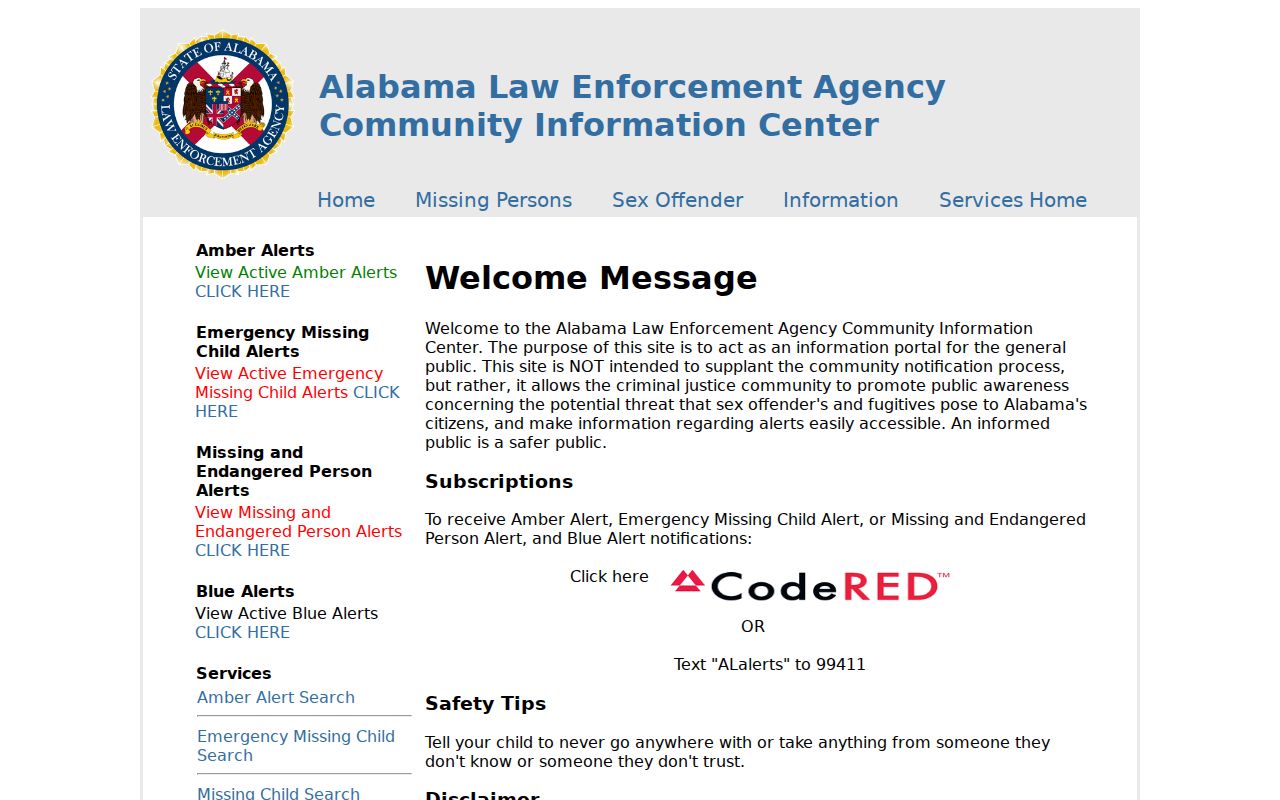
This gateway helps residents reach official notice tools without turning a map marker into a claim about current conduct.
Report Blount Registry Compliance Concerns
The Blount County Sheriff's Office is the local law-enforcement contact at 225 Industrial Park Road in Oneonta. Call 205-973-0517 during administrative hours, 8:00 a.m. to 5:00 p.m. on weekdays. The sheriff does not publish a separate registry-unit number, appointment schedule, or local fee, so call before appearing.
Describe the concern without confronting a registrant or posting an accusation online. Use 911 for an emergency or immediate threat. Nonemergency address or compliance concerns belong with the sheriff or ALEA. A public tip does not replace a registrant's own statutory reporting duties. Section 15-20A-22 sets a $10 payment to each registering agency at quarterly registration and when a new residence is established, with a court waiver or payment plan possible for indigency.
Note: Registry staff, not private map users, decide whether an address or reporting fact complies with Alabama law.
Lawful Use and Community Notification
Registry information supports personal, family, and neighborhood awareness. ALEA describes it as a supplement to community notification, not a replacement for official notice or direct law-enforcement help. Search results may change as agencies receive new reports. Readers should verify a concern through the registering agency and should never visit a listed address to investigate.
Use registry data lawfully: Alabama Code § 15-20A-1 et seq. governs registry notice. Harassment, threats, intimidation, trespass, vigilantism, and other unlawful misuse can be crimes. Report suspected noncompliance to law enforcement.
A calm review checks identifiers, reads the status in context, and uses official channels. It does not assume that a profile proves current presence, new misconduct, or every fact in the underlying case.